
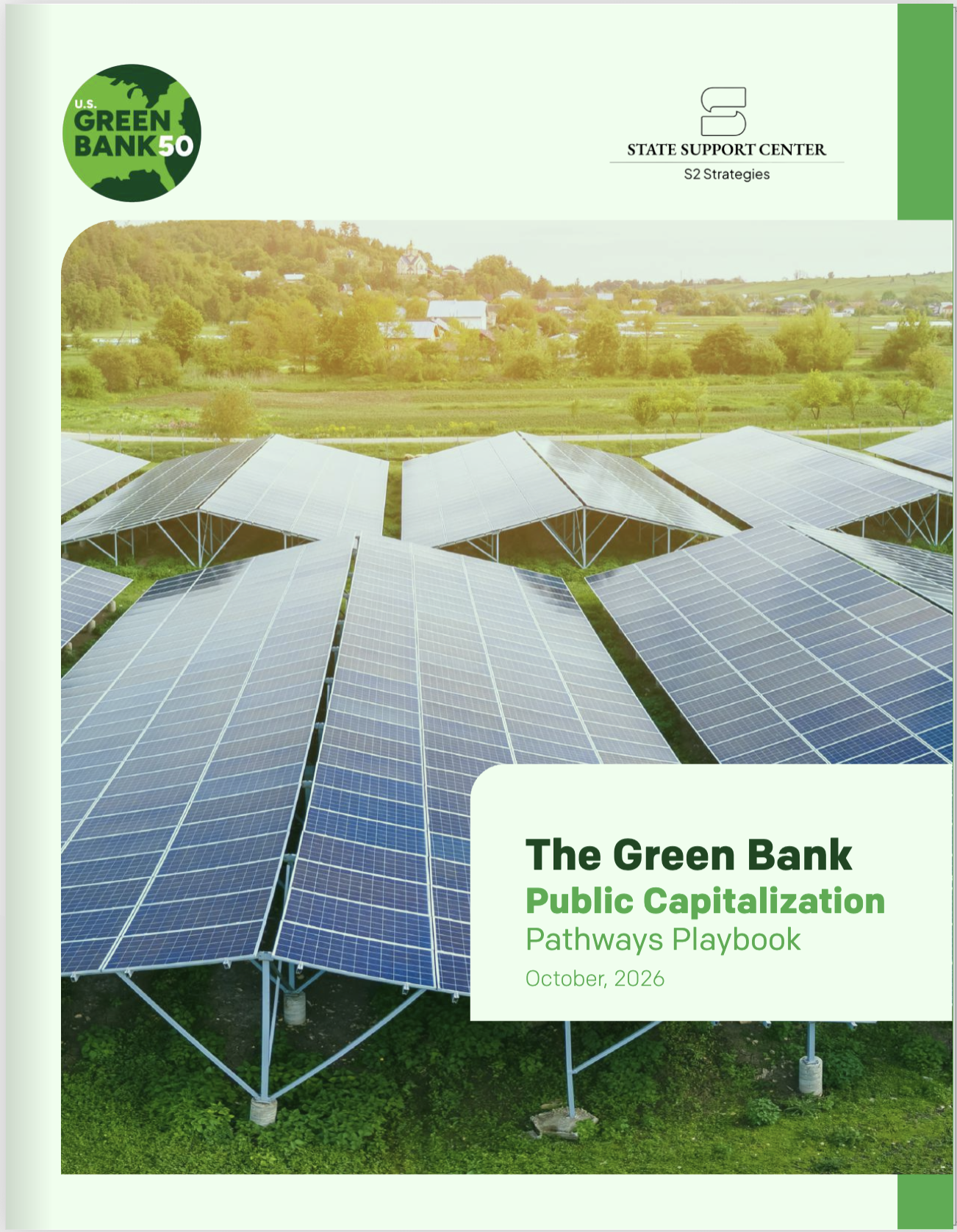
Let us guess. Your state’s energy goals are bigger than its budget for meeting them? This newsletter is devoted to one tool that can help: Green Banks. The new Green Bank Public Capitalization Pathways Playbook is now ready to guide you to launch or grow a Green Bank in your state.
"What is a Green Bank?" We knew you'd ask, so we wrote this one-pager for you. In short, Green Banks are mission-driven, place-based lenders that finance clean energy and community infrastructure projects often overlooked by traditional finance. They can be housed in state agencies, quasi-public entities, or nonprofits supported by the state. The projects enabled by Green Banks deliver interconnected forms of value: they lower energy costs for households and businesses, reduce emissions, and many improve affordable housing, while advancing the resilience and health of communities and the energy system at large. Green Banks are a beneficial and high-leverage public investment because they are catalytic and recycle capital. An impact report recently released by the U.S. Green Bank 50 (GB 50) showed that every $1 Green Banks invested brought in about $8 of private capital. More than half of those investments benefited low-income communities.
Show Me the Money: Many Green Banks are lean startups that currently fall short of self-sustainability. An infusion of new capital for Green Banks – such as we saw this year in Maryland, Washington, and California – would jump start many projects that cut energy costs, reduce emissions and increase reliability, financed by below-market rate lending. We know your state is likely facing budget constraints, and new dollars may be hard to come by. That's why the State Support Center teamed up with GB 50 to create the Green Bank Public Capitalization Pathways Playbook, a menu of financing levers your state may already have under existing authority. None of them require new state appropriations (though appropriations are always welcome!). The Playbook explains how each approach works and shares examples of where these tools are already in use, including:
Debt Issuance and Bonding
State Small Business Credit Initiative (SSBCI)
State Treasury Deposits
Settlement and Mitigation Funds
Renewable Energy Certificate (REC) Monetization
USDA Rural Energy Savings Program
Clean Water State Revolving Fund
Which options are feasible will depend on your state's statutes, institutions, and politics, and we're glad to help you sort out which pathways fit your state’s unique situation. Reach out to rachel@s2strategies.org to start a conversation. We're here to support you – it's right in our name.
Supportively,
The State Support Center Team