
Let’s get it started. More specifically, let’s “commence construction.” Months of uncertainty are over with the passage of the Budget Reconciliation bill (or the One Big Beautiful Bill Act) last week. We’re here to help you understand what the law means for your work and what states can and should do now. Explore our summary of the legislation here.
Our key message: Get started! Solar and wind energy projects that “commence construction” within one year of the bill’s enactment (July 4th, 2026) will still get 100% of the federal tax credits they’ve expected. After that, any solar and wind projects wanting to claim these 30%+ tax credits must be placed into service before the end of 2027. Tax credits for energy storage, geothermal, hydropower, nuclear and other zero-emission technologies continue with longer timelines. Importantly, new restrictive Foreign Entity of Concern (FEOC) rules apply for all of these energy credits starting next year. We’re encouraging you to do all you can to start your own projects and help others get started in time, and will be sharing more resources on “commence construction” and FEOC rules in the coming weeks.
Electing to Spend Smart: State agencies are still eligible to claim elective pay for energy projects for as long as the underlying credits are in effect. To help public agencies make the most of elective pay, we've partnered with Lawyers for Good Government and the Government Finance Officers Association to release a practical guide for states as filers for elective pay tax credits, packed with real-world case studies from Minnesota, Pennsylvania, Utah, and Massachusetts.
In Michigan, elective pay is already delivering real results. With support from the state government, organizations like the Presbyterian Church of Okemos, Lord of Lords Ministries in Detroit, and the Humane Society of Huron Valley have used elective pay to go solar.
We’re also excited to spotlight three standout resources: The Blueprint for Elective Pay by Lawyers for Good Government, a practical presentation from Deloitte, and RMI’s comprehensive guide on financing solar for tax-exempt organizations.
State Success Stories: Federally funded rebates and pollution reduction projects are taking off in states!
Georgia’s Home Energy Rebate Program has paid more than $1 million in rebates to residents upgrading their home appliances for energy efficiency.
The Michigan Home Energy Rebates (MiHER) program is now open statewide, offering households up to $34,000 in rebates.
Climate Pollution Reduction Grant (CPRG) projects are launching, too. Virginia is addressing methane pollution with Food Rescue and Composting at colleges, universities, and state agencies. And Colorado launched the Local IMPACT Accelerator to empower local and Tribal governments to advance policies to cut pollution from buildings, land use, transportation, and waste.
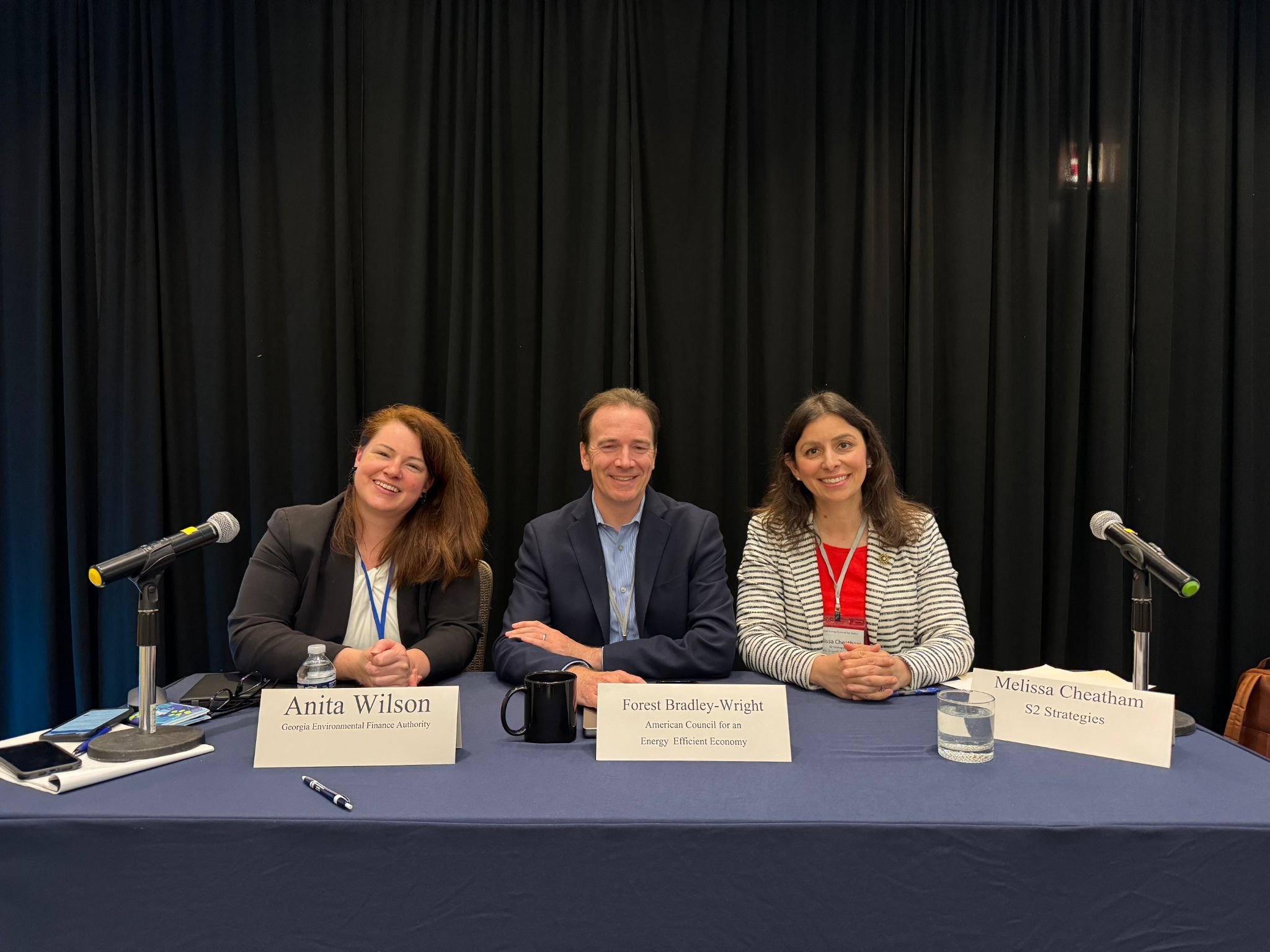
Program Director Melissa Cheatham spoke about Home Energy Strategies with Georgia's Anita Wilson and ACEEE's Forest Bradley-Wright during the Clean Energy States Alliance National Energy Summit in May.
Load Growth - Wow, That’s Formidable (WTF): The U.S. is entering a new era of electricity demand. A World Resources Institute webinar, “Managing Skyrocketing US Electricity Demand: A State and Local Perspective,” highlighted state policy strategies including managing demand, addressing new generation, and expanding transmission capacity. A number of our partners are digging in with state officials to help them understand their tools for addressing load growth. Please contact us if this topic is of interest to you, and we can connect you.
The pace of change – in policy and on the ground – is startling at the moment. We’re here to support you (it’s right in our name), so please reach out to talk, plan, or ask for help.
Sincerely,
The State Support Center